





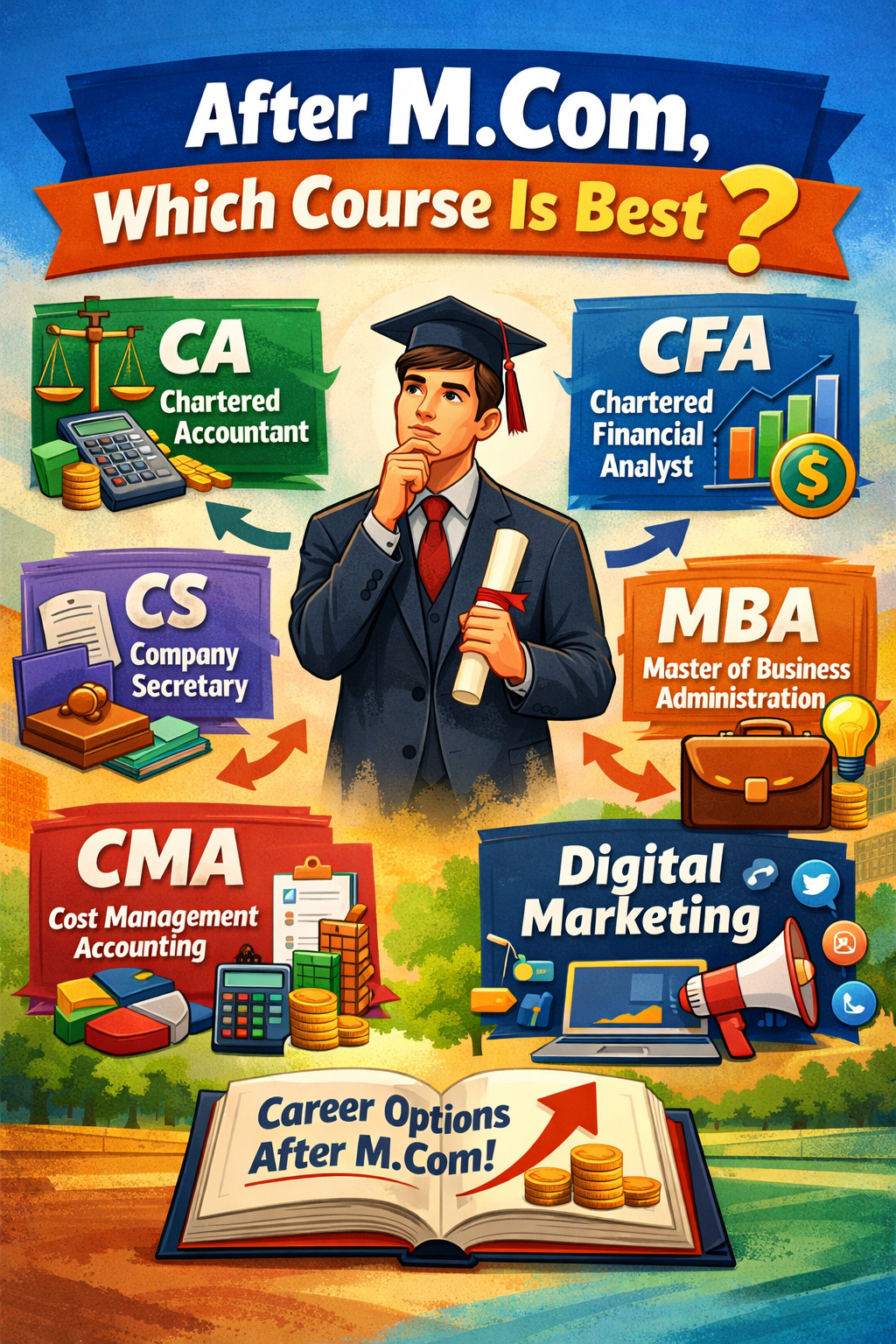
After M.Com, Which Course Is Best?
Introduction
Completing an M.Com degree is a significant academic achievement. You have already spent years studying commerce, accounting principles, corporate laws, financial management, economics, and taxation. However, once the degree is completed, a new and often more challenging question arises: what should you do next? Many students feel confused at this stage because the options available after M.Com are vast and diverse. Some offer high salaries, some provide job security, and others offer international opportunities. The real difficulty lies not in the lack of choices but in selecting the right one.
The truth is, there is no universal answer to the question, “After M.Com, which course is best?” The best course depends entirely on your personal interests, strengths, financial condition, career goals, and risk tolerance. In this detailed guide, every major option will be explained clearly in expanded paragraphs, allowing you to understand the scope, challenges, and long-term benefits before making your decision.
Self-Assessment Before Choosing a Course
Understanding Your Interests and Strengths
Before selecting any course, it is essential to evaluate your strengths and interests honestly. If you genuinely enjoy working with numbers, analyzing balance sheets, and understanding tax structures, then professional courses related to accounting and finance may suit you. On the other hand, if you prefer communication, leadership, strategy, and decision-making roles, then management-oriented courses might align better with your personality. Choosing a career path based solely on popularity or peer pressure often leads to dissatisfaction later. Your career will occupy a major portion of your life, so it must match your natural abilities and interests.
Defining Your Long-Term Career Vision
It is equally important to think about where you see yourself in the next ten to fifteen years. Do you imagine yourself working in a multinational corporation, holding a senior management role? Or do you see yourself preparing for competitive exams and serving in a government position? Some students dream of teaching at universities, while others want to start their own businesses. When you define your long-term vision, short-term course decisions become easier and more strategic.
Risk-Taking Ability vs Need for Stability
Different career paths carry different levels of risk. Professional certifications like CA or CFA require years of dedication and have challenging examinations, but they can lead to high-paying positions. Government jobs, on the other hand, offer stability and job security but may provide moderate salary growth. You must decide whether you are comfortable taking risks for potentially higher rewards or whether you prefer a stable and predictable career structure.
Financial Situation and Time Commitment
Some courses require substantial financial investment and several years of study. MBA programs from reputed institutions can be expensive, and professional courses demand both exam fees and preparation time. If you need to start earning quickly due to personal responsibilities, short-term certification programs may be a practical choice. Evaluating your financial condition and time availability ensures that your decision is realistic and sustainable.
Professional Courses After M.Com
Chartered Accountant (CA)
The Chartered Accountant qualification is one of the most respected professional certifications in commerce. It focuses on accounting, auditing, taxation, corporate law, and financial management. The course includes multiple levels of examinations and practical training under experienced professionals. Although it is challenging and requires consistent dedication, the rewards are significant. Qualified CAs often work in audit firms, multinational companies, financial institutions, or establish an independent practice. The earning potential increases with experience, and the professional credibility associated with the CA designation is exceptionally strong.
Company Secretary (CS)
The Company Secretary course is ideal for students interested in corporate law, governance, and compliance. A CS professional ensures that a company adheres to legal and regulatory frameworks. Their responsibilities include organizing board meetings, maintaining statutory records, and advising management on corporate policies. As businesses become more regulated, the demand for qualified CS professionals continues to grow. This course is particularly suitable for individuals who prefer legal and administrative roles rather than pure accounting work.
Cost and Management Accountant (CMA)
CMA focuses on cost control, budgeting, and strategic financial planning. It is especially valuable in manufacturing industries and corporate finance departments where cost efficiency and profit maximization are crucial. The course trains students to analyze financial data and assist management in making informed business decisions. While it may not receive as much public attention as CA, it provides strong career stability and respectable income prospects.
Chartered Financial Analyst (CFA)
The CFA program is globally recognized and ideal for students passionate about investment management and financial markets. It covers topics such as equity research, portfolio management, corporate finance, and risk analysis. The certification is highly valued in the investment banking and asset management sectors. Although it demands rigorous study and discipline, the international recognition of CFA opens doors to global career opportunities.
MBA and Management Courses
MBA in Finance
An MBA in Finance enhances your managerial skills along with financial expertise. It prepares you for roles in corporate finance, banking, financial consulting, and investment management. The program develops analytical thinking and leadership abilities, enabling graduates to take on decision-making responsibilities within organizations.
MBA in Marketing
An MBA in Marketing focuses on consumer behavior, branding, sales strategy, and digital marketing. It is suitable for students who enjoy creativity combined with business strategy. Marketing professionals play a crucial role in revenue generation and business expansion.
MBA in Human Resource Management
This specialization prepares you to manage recruitment, training, employee relations, and organizational development. HR professionals contribute significantly to shaping company culture and workforce productivity.
Executive MBA
Designed for working professionals, the Executive MBA allows individuals to upgrade their qualifications without leaving their jobs. It enhances leadership capabilities and improves promotion prospects.
Skill-Based and Short-Term Courses
Financial Modeling
Financial modeling courses teach practical skills required in corporate finance and investment banking. Students learn to build financial projections and valuation models using spreadsheets.
Data Analytics
Data analytics combines business knowledge with technology. It enables professionals to interpret large datasets and assist organizations in making data-driven decisions.
Digital Marketing
Digital marketing courses cover search engine optimization, social media marketing, content strategy, and online advertising. The field offers freelancing, remote work, and entrepreneurial opportunities.
Investment Banking Courses
These certifications provide specialized knowledge in mergers, acquisitions, and capital markets, preparing students for high-pressure yet high-reward careers.
Government Career Options
Government jobs remain popular due to job security and structured growth.
UPSC Civil Services
UPSC preparation demands full dedication and extensive study. Successful candidates serve in prestigious administrative roles.
Banking Exams
Bank PO and related exams align well with commerce backgrounds and offer stable career progression.
SSC and State PSC
These exams provide opportunities in various government departments with long-term security.
Salary Comparison and Career Growth
Professional certifications like CA and CFA generally offer higher earning potential. MBA salaries depend heavily on the reputation of the institution. Government jobs provide stability but moderate financial growth. Skill-based courses may offer faster entry into growing industries.
How to Choose the Best Course for You
Evaluate your interests, financial situation, risk tolerance, and long-term goals carefully. There is no single “best” course. The best option is the one that aligns with your ambitions and capabilities.
Conclusion
After M.Com, you have multiple career paths available. Whether you choose professional certification, management studies, government preparation, academic research, or skill-based courses, your success will depend on dedication and clarity. Choose wisely, commit fully, and build your future strategically.
FAQs
1. Which course offers the highest salary after M.Com?
Professional certifications such as CA and CFA generally provide higher salary potential.
2. Is an MBA necessary after M.Com?
It is not mandatory, but it can significantly enhance managerial career opportunities.
3. Are short-term courses effective?
Yes, especially in fast-growing fields like analytics and digital marketing.
4. Can I pursue government exams after M.Com?
Yes, many commerce graduates successfully enter government services.
5. Should I pursue international certifications?
If you aim for global career exposure, certifications like ACCA, CPA, or CFA are beneficial.
Recently Added Articles



.webp)






 Book A Free Demo
  7568111008
 Apply Now


 Please select course category