





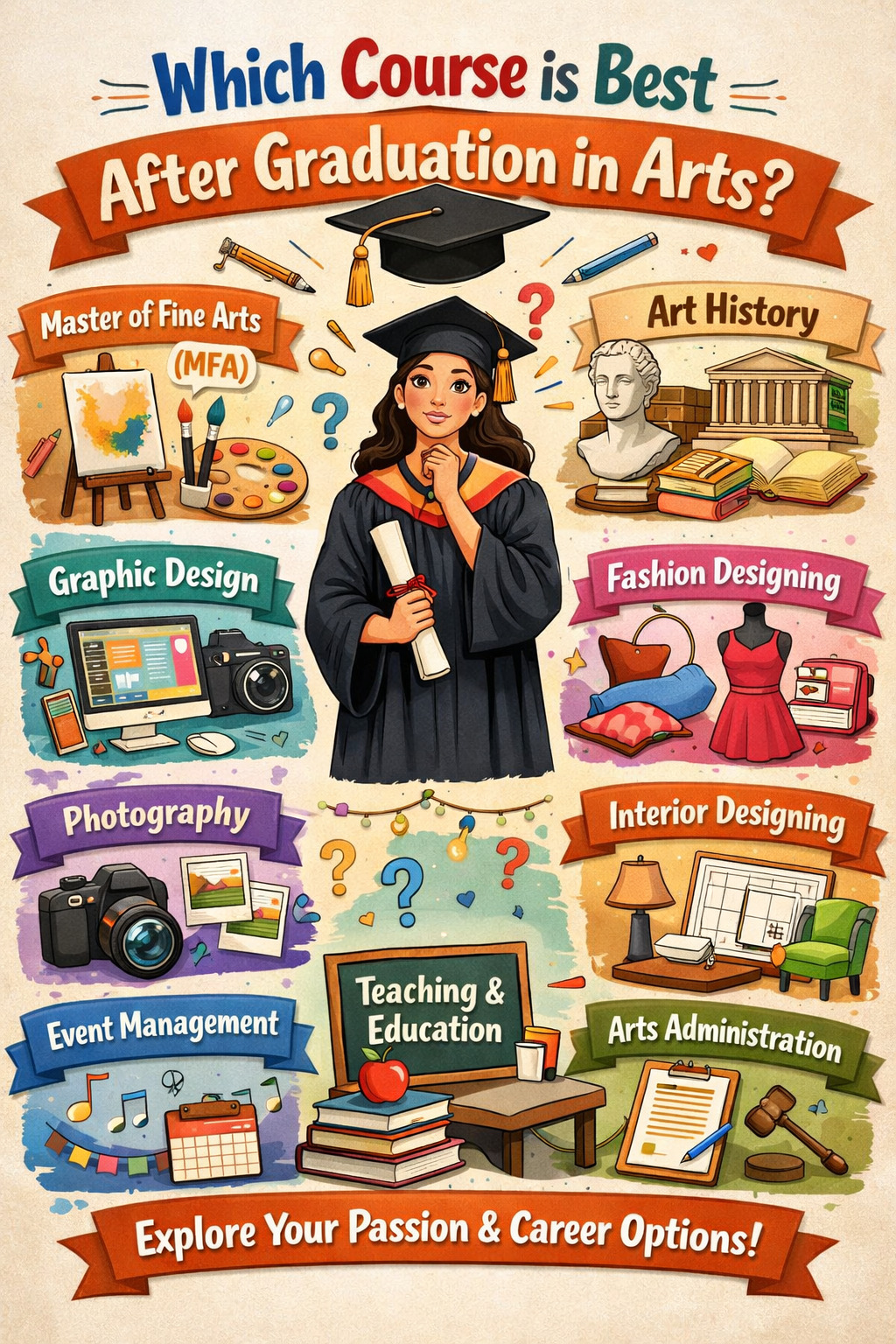
Which Course Is Best After Graduation in Arts?
Choosing the right course after completing a Bachelor of Arts (BA) can feel overwhelming. One moment you’re celebrating graduation, and the next you’re staring at dozens of career options, wondering, “What should I do now?” If you’re asking yourself which course is best after graduation in arts, you’re already on the right track — because awareness is the first step toward clarity.
Let’s be honest. Arts students often hear myths like “limited scope” or “low salary options.” But here’s the truth: arts graduates have some of the most versatile and adaptable skill sets in today’s job market. Communication, analytical thinking, creativity, research ability, and emotional intelligence — these are not small things. These are powerful career tools.
The key isn’t asking, “Which course is best?”
The real question is, “Which course is best for me?”
The real question is, “Which course is best for me?”
Let’s explore your options in depth.
Master of Arts (MA): Deepen Your Academic Expertise
If you genuinely love your graduation subject, pursuing a Master of Arts (MA) can be a powerful next step. An MA allows you to specialize deeply in subjects like English, Political Science, Psychology, Sociology, History, or Economics. Instead of just studying the basics, you begin exploring advanced theories, research methodologies, and specialized knowledge.
An MA is especially suitable for students who are passionate about academics, research, writing, or teaching. If you enjoy reading extensively, analyzing ideas, debating concepts, and exploring historical or social patterns, this path may feel natural.
After completing an MA, many students prepare for the UGC NET to become assistant professors or lecturers. Others enter research, policy analysis, content strategy, or publishing. The academic path may not always provide instant high salaries, but it offers intellectual growth and long-term stability.
If you see yourself guiding students or contributing to research papers one day, an MA could be the right fit.
MBA: Entering the Corporate World with Confidence
If you want to shift toward business, leadership, and corporate careers, an MBA is one of the most powerful options after a BA. Many arts students wrongly assume an MBA is only for commerce or engineering graduates — but that’s simply not true.
Arts students often perform exceptionally well in MBA programs because they already possess communication and analytical strengths. Marketing, Human Resources, Media Management, and International Business are especially suitable specializations.
An MBA transforms your career direction. It moves you from subject-focused learning to business strategy, problem-solving, and organizational management. After an MBA, career roles can include Marketing Manager, HR Manager, Brand Strategist, Business Development Executive, or even Entrepreneur.
The earning potential significantly increases if you graduate from a reputed institute. However, even average institutions can offer good returns if you build strong internships and skills.
If you enjoy leadership, teamwork, persuasion, and decision-making, an MBA might be your gateway to corporate success.
B.Ed.: Building a Career in Teaching
Teaching is not just a profession — it’s a responsibility. If you feel fulfilled while explaining concepts, guiding others, and shaping young minds, then the Bachelor of Education (B.Ed.) is a strong option.
After completing BA, B.Ed. takes around two years. It qualifies you to teach in schools, and if combined with CTET or state-level exams, it can open doors to government teaching jobs.
Teaching offers emotional satisfaction, stable income, and respectable social status. Unlike many corporate jobs, teaching also provides structured working hours and holidays.
If you’re patient, empathetic, and passionate about mentoring, this path can offer long-term fulfillment.
Digital Marketing: The Modern Career Powerhouse
Digital marketing has exploded in demand over the last decade. Every business today — whether small or multinational — needs online visibility. That means they need SEO experts, social media managers, content marketers, performance marketers, and brand strategists.
Arts students are naturally strong in creativity and communication, which are core pillars of digital marketing. Learning SEO, Google Ads, content marketing, email campaigns, and analytics can transform you into a high-demand professional within 6–12 months.
One of the biggest advantages? You can start freelancing early. You don’t need years of study. With the right certifications and portfolio, you can begin earning quickly.
If you enjoy social media trends, storytelling, the psychology of consumers, and creative campaigns, digital marketing is a high-growth field worth serious consideration.
UI/UX Design: Creativity Meets Technology
UI/UX design focuses on how users interact with websites and apps. It blends psychology, design thinking, and user behavior.
As an arts graduate, your understanding of human emotions and communication gives you an advantage here. Learning tools like Figma, Adobe XD, and user research techniques can open doors to tech companies, startups, and global clients.
UI/UX designers are highly paid because they directly impact customer experience. Every company wants smooth, attractive, and user-friendly digital platforms.
If you enjoy design, creativity, and solving practical problems, this field can be both exciting and financially rewarding.
Web Development: A Skill-Based Career with High Demand
You might think coding is complicated — but many arts students successfully transition into web development every year. With consistent practice, anyone can learn HTML, CSS, JavaScript, and backend technologies.
Web development allows remote work, freelancing, and global job opportunities. You can build websites for businesses, startups, and individuals. The demand is consistent and growing.
If you’re willing to invest time in technical learning, web development can offer independence and strong earning potential.
Data Science: Breaking the Myth
Data science sounds intimidating. But with structured learning in Python, statistics, and data analysis, arts students can enter this field too.
Data analysts help companies interpret numbers and trends to make better decisions. While it requires logical thinking and some mathematical understanding, it is not impossible.
If you enjoy patterns, research, and problem-solving, data analytics or data science could be a powerful and future-proof career.
Animation, Video Editing & Multimedia Careers
If you are creative and visually expressive, animation and multimedia can transform your passion into income. From YouTube creators to film studios, everyone needs editors and visual designers.
Learning software like Adobe Premiere Pro, After Effects, Blender, and Photoshop can build a strong creative career. Freelancing in weddings, brand shoots, YouTube editing, or advertising campaigns can generate consistent income.
This field rewards creativity, consistency, and strong portfolio building.
Government Exams: Stability and Prestige
Many arts students prepare for UPSC, SSC, banking exams, and state-level government services. These careers provide stability, structured growth, and social prestige.
However, government exams demand patience, discipline, and long-term preparation. Success requires focused study plans and consistency.
If you value job security and public service, this path remains one of the strongest traditional options.
Law (LLB): A Respected Professional Path
After BA, you can pursue a 3-year LLB program. Law offers diverse career opportunities — litigation, corporate law, legal advisory, judiciary exams, and more.
If you enjoy debating, critical thinking, and understanding legal systems, law can be intellectually rewarding and financially strong.
Foreign Language Courses: Global Opportunities
Learning languages like French, German, Spanish, or Japanese opens global career options. You can work as a translator, interpreter, language trainer, or with multinational companies.
In a globalized world, language skills are powerful career assets.
How to Choose the Best Course After BA
There is no universal “best course.” The right choice depends on:
- Your interest
- Your financial situation
- Market demand
- Your strengths
- Long-term career goals
Imagine your life 10 years from now. What kind of work environment do you see? Corporate office? Classroom? Courtroom? Creative studio? Government office?
Your answer will guide you.
Conclusion
Which course is best after graduation in arts? The real answer is: the one that aligns with your passion, strengths, and long-term vision.
Arts graduation is not a limitation — it is a flexible foundation. Whether you choose MBA, digital marketing, UI/UX, government exams, law, teaching, or creative fields, your success will depend more on skill development and consistency than on your degree label.
Choose wisely. Act boldly. And remember — your career is a marathon, not a sprint.
FAQs
1. Can arts students pursue technical courses like web development?
Yes, absolutely. With structured learning and practice, arts students can succeed in technical fields.
Yes, absolutely. With structured learning and practice, arts students can succeed in technical fields.
2. Is an MBA better than an MA after a BA?
It depends on your career goal. MBA suits corporate careers; MA suits academic and research paths.
It depends on your career goal. MBA suits corporate careers; MA suits academic and research paths.
3. Which short-term course is best after BA?
Digital marketing, UI/UX design, and data analytics are strong short-term options.
Digital marketing, UI/UX design, and data analytics are strong short-term options.
4. Can arts students earn high salaries?
Yes. Salary depends on skill, experience, and industry — not just your graduation stream.
Yes. Salary depends on skill, experience, and industry — not just your graduation stream.
5. Is a government job preparation a good choice after a BA?
Yes, if you’re ready for disciplined preparation and long-term commitment.
Yes, if you’re ready for disciplined preparation and long-term commitment.
Recently Added Articles


.webp)


 Book A Free Demo
  7568111008
 Apply Now


 Please select course category