





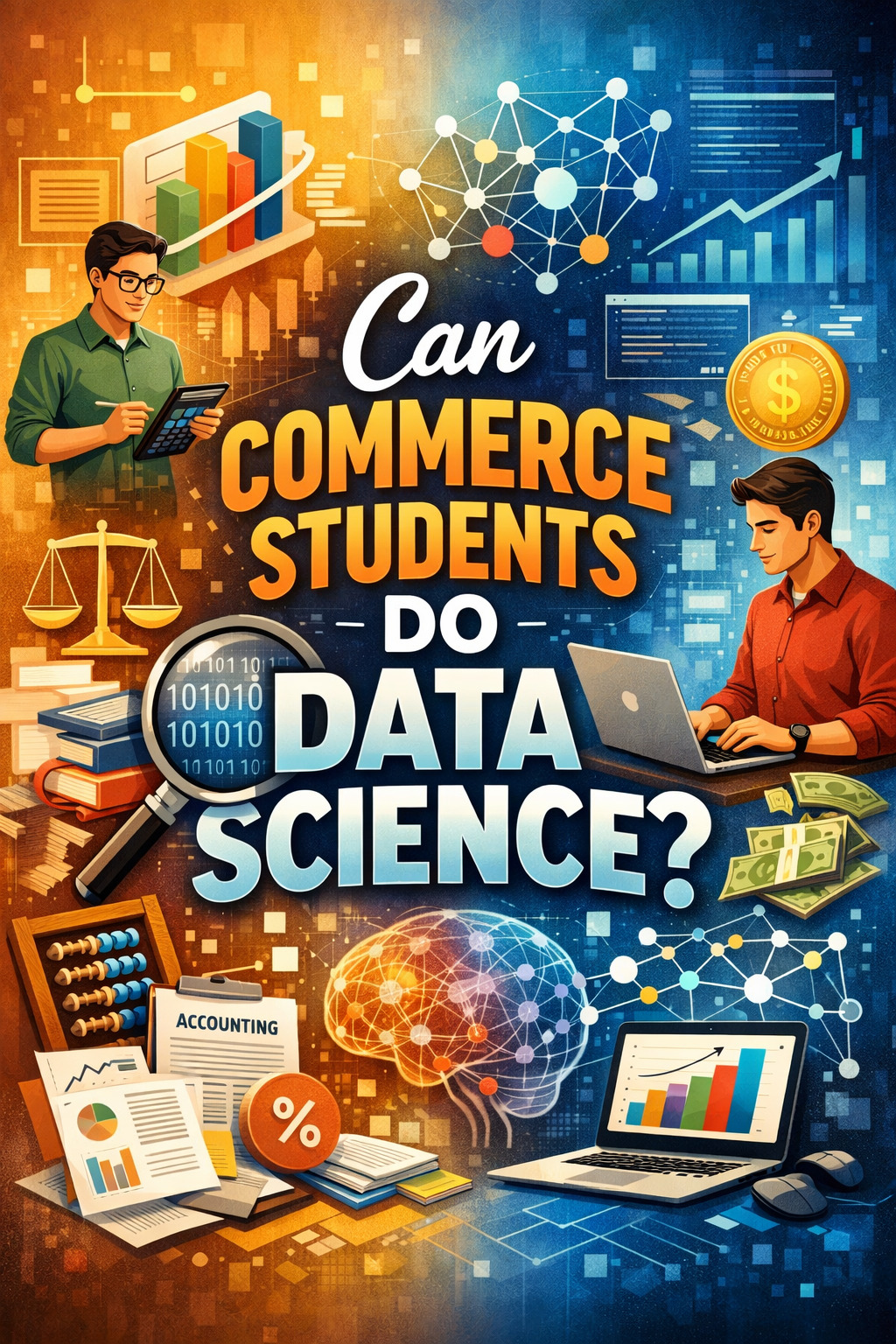
Can Commerce Students Do Data Science?
Introduction
Why Data Science Is Attracting Students from All Backgrounds
Over the last few years, data science has evolved from a technical buzzword into one of the most powerful career opportunities in the global job market. Companies today are no longer making decisions based only on experience or instinct; they rely heavily on data-driven insights. Every digital activity — whether it is online shopping, digital payments, social media interaction, or stock trading — generates massive volumes of data. Businesses need professionals who can interpret this data and convert it into strategic decisions. Because of this massive demand, students from science, arts, and commerce backgrounds are all exploring this field with curiosity and ambition.
The Common Doubt Among Commerce Students
If you are from a commerce background, chances are you’ve questioned your eligibility. You may think that since you didn’t study physics, chemistry, or advanced mathematics, you are already at a disadvantage. Many commerce students assume that data science is reserved exclusively for engineers or computer science graduates. This belief often creates hesitation and self-doubt. However, the truth is far more encouraging. Data science is not about your academic stream; it is about your ability to learn new skills and apply logical thinking to solve problems. Commerce students are more capable than they often realize.
What Exactly Is Data Science?
Breaking Down Data Science in Simple Terms
Data science is essentially the process of collecting, cleaning, analyzing, and interpreting data to extract meaningful insights. Imagine a company has thousands of sales transactions recorded over several years. Without analysis, that data is just numbers stored in a system. A data professional studies those numbers to discover patterns — which products sell more during certain months, which customers buy repeatedly, or which marketing campaigns generate higher profits. Data science transforms raw numbers into valuable business intelligence. It is a blend of programming, statistics, and domain knowledge working together.
The Role of Data in Modern Businesses
Modern businesses function in a highly competitive environment. Decisions about pricing, marketing, expansion, and investments must be made carefully. Data provides clarity. For example, an e-commerce company may analyze customer behavior to personalize recommendations. A bank may examine transaction patterns to detect fraud. A retail brand may study purchasing trends to manage inventory efficiently. In every case, data science helps reduce uncertainty and improve decision-making accuracy. This is why organizations are actively hiring data professionals across industries.
How Data Science Connects to Commerce
Commerce students study subjects like accounting, economics, finance, taxation, and business management. These subjects revolve around analyzing financial data, understanding market behavior, and evaluating performance. Data science enhances these abilities by adding technical tools. For instance, instead of manually analyzing financial statements, you can use programming to process thousands of records in seconds. Instead of making sales forecasts using simple calculations, you can apply predictive models. In essence, data science acts as a technological extension of commerce knowledge.
Is a Commerce Background a Disadvantage?
The Myth That Only Engineers Can Do Data Science
One of the biggest misconceptions is that only engineering graduates can enter data science. This myth exists because many data science professionals originally came from technical backgrounds. However, the field has evolved. Employers now focus more on skills and practical experience rather than academic labels. If you can demonstrate strong analytical ability, programming knowledge, and project experience, your commerce degree will not hold you back.
The Reality of Skill-Based Hiring
The hiring process in data-related roles is largely skill-oriented. Recruiters assess your problem-solving ability, understanding of data concepts, and project portfolio. They may ask you to analyze a dataset or solve a case study. If you perform well, your academic stream becomes less significant. Many companies value diverse perspectives because business-oriented thinking combined with technical skills often leads to better insights.
Hidden Advantages of Commerce Students
Analytical and Logical Thinking
Commerce subjects require critical thinking. When preparing financial statements or analyzing economic trends, you interpret numbers logically. This analytical mindset is fundamental in data science. You are already trained to identify patterns and discrepancies, which makes learning advanced analytics smoother.
Financial and Business Understanding
One of the strongest advantages commerce students have is business knowledge. Data science is most powerful when applied to business problems. Understanding revenue models, cost structures, taxation systems, and market forces gives you an edge. You can interpret data not just technically but strategically.
Existing Knowledge of Statistics
Most commerce programs include statistics courses. Concepts such as mean, variance, correlation, and regression are not new to you. While you may need to deepen your knowledge, you already possess a foundational understanding that many beginners lack.
Skills Commerce Students Must Develop
Learning Programming from Scratch
Programming is the main technical skill required in data science. Python is highly recommended due to its simplicity and wide industry use. At first, coding may feel overwhelming, especially if you have never written a line of code before. However, programming is a skill that improves with consistent practice. Begin with basics like variables, loops, and functions. Gradually move toward data manipulation libraries such as Pandas and NumPy. Over time, what once seemed complex will become second nature.
Strengthening Mathematics and Statistics
Although advanced mathematics is not mandatory, you must understand applied statistics thoroughly. Probability, hypothesis testing, distributions, and regression analysis are frequently used in data projects. Instead of memorizing formulas, focus on understanding concepts and real-world applications. This approach makes learning more practical and less intimidating.
Mastering Data Visualization
Data visualization is the art of presenting data in a clear and compelling way. Tools like Excel, Power BI, Tableau, and Python visualization libraries help create charts and dashboards. Commerce students already have experience preparing reports and presentations. Data visualization simply enhances this ability using advanced tools.
Understanding Machine Learning Step by Step
Machine learning involves teaching computers to recognize patterns and make predictions. Begin with simple models like linear regression and decision trees. Focus on understanding the logic behind predictions rather than memorizing algorithms. As your confidence grows, you can explore more advanced techniques.
Step-by-Step Roadmap for Commerce Students
Step 1 – Build Conceptual Clarity
Start by strengthening your understanding of statistics and business fundamentals. Clear concepts form the backbone of advanced learning.
Step 2 – Practice Coding Consistently
Dedicate daily time to coding practice. Solve small exercises and gradually move to larger datasets. Consistency builds confidence.
Step 3 – Work on Business-Focused Projects
Choose projects related to finance, sales, marketing, or economics. For example, analyze stock trends or predict sales growth. This connects your commerce background with technical skills.
Step 4 – Create a Job-Ready Portfolio
Upload your projects to GitHub and document your learning journey. A strong portfolio showcases practical skills to employers.
Step 5 – Enter the Industry Strategically
Apply for entry-level roles such as Data Analyst or Business Analyst. Gain experience and gradually transition into advanced roles.
Career Options After Learning Data Science
Data Analyst
Data analysts interpret data and generate reports. This is often the starting point for many professionals.
Business Analyst
Business analysts bridge the gap between data and management decisions. Commerce students often excel in this role.
Data Scientist
Data scientists build predictive models and solve complex problems using machine learning techniques.
Financial Data Specialist
This role focuses on analyzing financial datasets. Commerce graduates have a natural advantage here.
Salary Growth and Long-Term Career Scope
Data science offers strong salary growth compared to many traditional commerce roles. Entry-level salaries are competitive, and with experience, compensation increases significantly. As businesses become more data-driven, long-term demand remains strong.
Challenges Commerce Students May Face
You may initially struggle with coding syntax or technical jargon. You might compare yourself with engineering peers and feel behind. However, persistence is key. With regular practice and project work, these challenges gradually fade.
Final Verdict
Commerce students can absolutely pursue data science successfully. The combination of business knowledge and technical skills creates powerful career opportunities. Your background is not a limitation — it is a foundation.
Conclusion
So, can a commerce student do data science? The answer is a confident yes. With dedication, structured learning, and consistent practice, transitioning into this field is entirely possible. Data science values skills, analytical thinking, and problem-solving ability — qualities commerce students already possess. By adding programming and advanced analytics to your toolkit, you open doors to a dynamic and rewarding career path.
FAQs
1. Is data science difficult for commerce students?
It may seem challenging at first, but with consistent practice, it becomes manageable.
2. How long does it take to become job-ready?
Typically 6–12 months of focused learning and project work.
3. Do I need advanced mathematics?
No, practical statistics is more important than complex mathematics.
4. Which programming language should I start with?
Python is the most recommended for beginners.
5. Can I switch careers after B.Com?
Yes, many commerce graduates successfully transition into data-related roles.
Recently Added Articles


.webp)






 Book A Free Demo
  7568111008
 Apply Now


 Please select course category