





AI Career Scope in India 2026: Jobs, Skills & Salary You Need to Know
Last updated on Sep 07, 2026


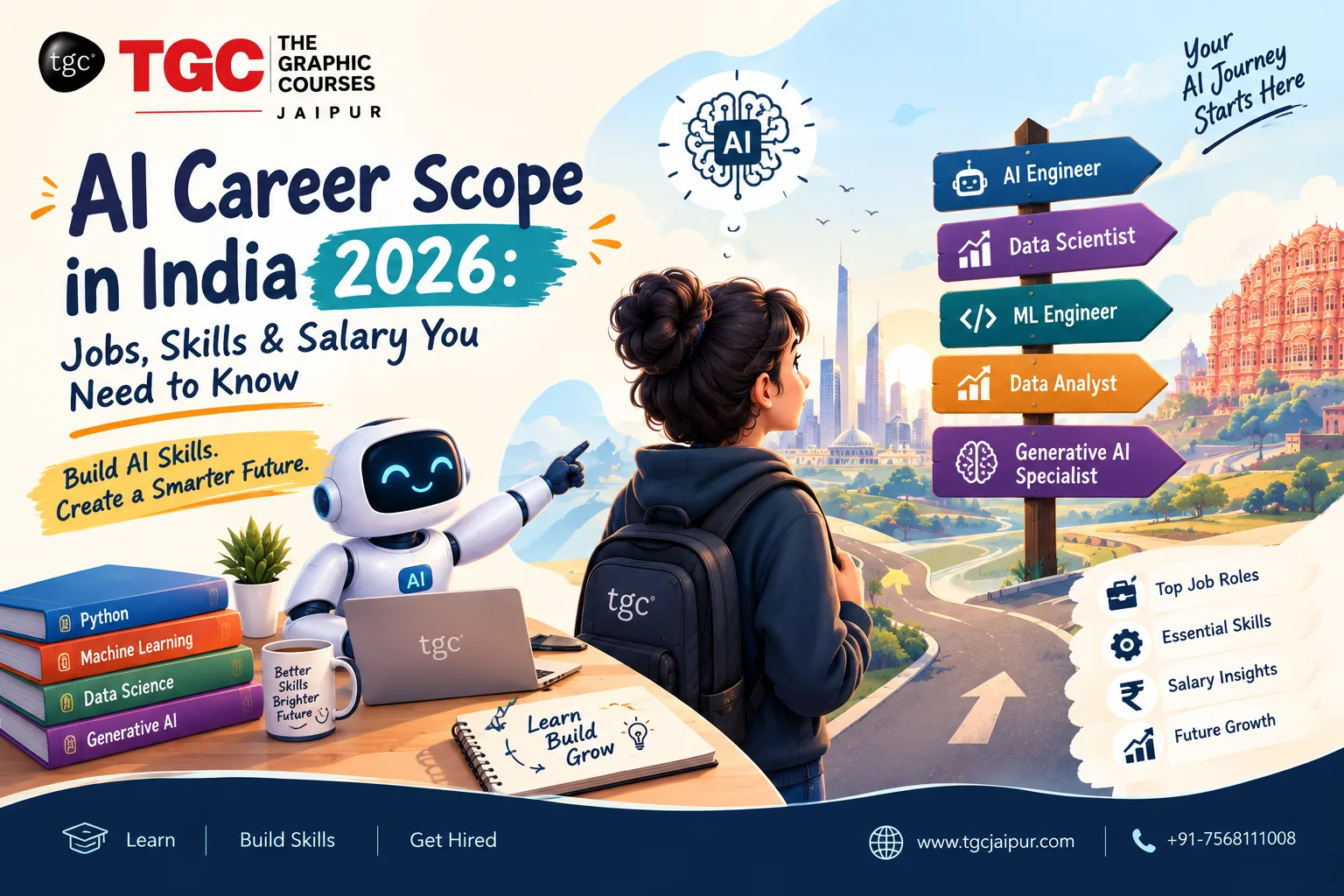
AI Career Scope in India 2026: Jobs, Skills & Salary You Need to Know
Artificial Intelligence has moved from buzzword to backbone of the Indian tech economy. India's AI market is now valued at roughly USD 22.8 billion, on track to reach close to USD 34 billion by the end of 2026, growing at a striking 38.1% compound annual rate through 2033. Behind those numbers is a simple reality: companies across every sector — finance, healthcare, e-commerce, manufacturing — are hiring AI talent faster than the market can supply it.
If you're weighing whether to build a career in AI in 2026, this guide covers everything you need: the roles actually hiring, the skills that command premium salaries, realistic pay expectations at every experience level, and how to actually break in.
Why AI Careers Are Booming in India Right Now
A few forces are driving this surge simultaneously:
- Talent shortage against soaring demand — industry projections estimate India's AI talent demand will exceed 1.25 million professionals by 2027, while the current AI workforce is only a fraction of that
- The Generative AI wave — the explosion of large language models (LLMs) like GPT-style systems since 2022–23 has created entirely new, high-paying specializations that didn't exist a few years ago
- Every industry is adopting AI — from automated customer service and fraud detection in fintech to diagnostic tools in healthcare and demand forecasting in retail
- Global companies building India teams — Google, Microsoft, Meta, NVIDIA, and major GCCs (Global Capability Centers) are expanding AI teams in India, driving both job volume and compensation upward
Top AI Job Roles in India for 2026
AI isn't one job — it's an umbrella covering multiple specialized roles, each with distinct skill requirements and pay scales.
| Role | What They Do | Best Suited For |
|---|---|---|
| Machine Learning Engineer | Builds and deploys ML models into production systems | Strong coders who enjoy engineering + math |
| Data Scientist | Analyzes data, builds predictive models, generates insights | Analytical thinkers who enjoy statistics |
| Generative AI / LLM Engineer | Builds applications using large language models, fine-tuning, RAG pipelines | Those excited by the cutting edge of AI |
| AI Research Scientist | Develops new algorithms and advances AI capabilities | Deeply technical, research-oriented minds |
| Computer Vision Engineer | Builds systems that interpret images and video | Specialists interested in visual AI applications |
| MLOps Engineer | Manages infrastructure and pipelines for deploying ML at scale | Engineers who enjoy systems and DevOps-style work |
| Prompt Engineer / Agentic AI Developer | Designs prompts and multi-agent AI systems for real-world tasks | A newer, fast-growing niche for GenAI specialists |
| AI Testing Engineer | Tests and validates AI systems, often transitioning from QA/automation | Automation testers upskilling into AI |
AI Salary in India 2026: Full Breakdown
Salary in AI varies enormously based on role, specialization, city, and company type — but the overall trend is clear: this is one of the highest-paying technical fields in India right now, and pay has grown roughly 15–20% year-on-year.
By Experience Level
| Experience Level | Typical Annual Salary (CTC) |
|---|---|
| Fresher (0–2 yrs) | ₹5L – ₹12L (strong candidates with real projects can start near ₹15L) |
| Early Career (2–4 yrs) | ₹10L – ₹18L |
| Mid-Level (4–6 yrs) | ₹15L – ₹30L |
| Senior (7–10 yrs) | ₹25L – ₹52L |
| Lead / Principal / Architect | ₹50L – ₹80L+ |
By Specialization (2026 Premium Roles)
| Specialization | Fresher/Junior Pay | Senior/Expert Pay |
|---|---|---|
| Traditional ML Engineer | ₹8L – ₹12L | ₹35L – ₹75L |
| Data Scientist | ₹8L – ₹12L | ₹25L – ₹45L |
| GenAI / LLM Engineer | ₹15L – ₹25L | ₹40L – ₹80L |
| Prompt Engineer | ₹6L – ₹12L | ₹20L – ₹40L |
| Agentic AI Developer | ₹12L – ₹20L | Still an emerging category — early data suggests strong premiums for proven, deployed systems |
| AI Testing Engineer (upskilled from QA) | ₹12L – ₹15L | ₹18L – ₹22L |
Note: Figures are compiled from current 2026 industry salary reports (Glassdoor, Indeed, AmbitionBox, Naukri, and specialized AI salary guides) and represent directional CTC ranges. Actual pay varies by company tier — service companies like TCS, Infosys, and Wipro typically offer the lower end, while product companies and global tech firms (Google, Microsoft, Meta, NVIDIA India) pay significantly above these ranges.
By City
Bengaluru consistently leads AI compensation in India, followed by Hyderabad and Gurgaon, which typically pay 15–25% more than Pune and Chennai. That said, remote and hybrid AI roles are increasingly narrowing this geographic gap, allowing skilled professionals in cities like Jaipur to access competitive, near-metro salaries without relocating.
Skills That Actually Drive Higher AI Salaries in 2026
Not all AI skills are valued equally. Based on current hiring and salary data, these specific skills correlate directly with higher pay:
- Python — the non-negotiable foundation of virtually every AI and ML role
- Machine learning frameworks — TensorFlow and PyTorch remain core requirements for most engineering roles
- LLMs and Generative AI tools — working with models like GPT-style systems, LangChain, and Hugging Face is now one of the top-paying skill combinations in the market
- MLOps and cloud platforms — AWS, GCP, or Azure experience is essential for deploying and scaling AI models in real production environments
- RAG (Retrieval-Augmented Generation) and fine-tuning — specialized LLM skills that command some of the strongest salary premiums this year
- Business understanding — the ability to align AI solutions with actual business goals significantly increases a candidate's value, especially at senior levels
Notably, industry data shows that engineers who add GenAI, MLOps, or LLM engineering skills to a traditional machine learning background can command 20–40% higher offers compared to peers at the same experience level without these specializations.
A Realistic AI Career Roadmap
Based on current industry patterns, here's how a typical AI career tends to progress:
| Stage | Focus |
|---|---|
| 0–2 Years | Build fundamentals — Python, statistics, and core ML concepts; complete small AI projects or open competitions |
| 2–5 Years | Specialize — move into NLP, computer vision, GenAI, or MLOps depending on interest and market demand |
| 5+ Years | Lead — design AI systems, mentor teams, consult across products, or move toward AI architecture and strategy roles |
The key insight here: specialization pays significantly more than staying a generalist. Professionals who deliberately build depth in a high-demand niche — especially GenAI/LLM engineering — tend to see the sharpest salary growth over a 3–5 year window.
Is a Formal Degree Required for an AI Career?
Increasingly, no — not exclusively. While a strong educational background in AI, data science, or computer science helps, employers today place heavy emphasis on demonstrable skills, hands-on projects, and problem-solving ability over credentials alone. A well-built project portfolio, practical certifications, and real deployment experience often matter more to hiring managers than a degree by itself — which is exactly why structured, project-based AI training programs have become such a fast, effective entry point into the field.
Where to Learn AI in Jaipur
Building genuine AI skills requires more than watching scattered tutorials — it requires structured training with real projects and expert mentorship. TGC Jaipur's AI Course in Jaipur covers the complete foundation employers look for: machine learning, deep learning, natural language processing, computer vision, generative AI, and Python programming, along with practical exposure to large language models, ChatGPT-style systems, and transformers — taught by trainers with real-world AI project experience.
For students who want to build AI skills alongside strong data fundamentals, the Data Science Course in Jaipur combines data analytics, machine learning, and AI tools through real-world projects — an excellent starting point for anyone unsure whether to specialize in data science or pure AI engineering first.
Creative professionals looking to apply AI within design, video, and content workflows can also explore TGC Jaipur's growing range of Generative AI courses available across multiple Jaipur locations, which blend AI tools with practical creative production skills — reflecting how AI fluency is becoming valuable well beyond traditional engineering roles.
Final Thoughts
AI career scope in India for 2026 isn't hype — it's backed by real market growth, a significant talent shortage, and salary data that consistently rewards specialization and hands-on skill over credentials alone. Whether you're drawn to machine learning engineering, generative AI, data science, or the fast-emerging agentic AI space, the opportunity is genuine — but capturing it requires deliberate skill-building, not just casual curiosity.
For anyone serious about this field, the path is clear: master Python and ML fundamentals, build real projects, choose a specialization aligned with where the market is heading, and get structured, practical training that mirrors how the industry actually works.
Ready to start your AI career? Explore TGC Jaipur's Artificial Intelligence course and get hands-on, industry-relevant training designed to get you job-ready in 2026.
Recently Added Articles


.webp)





 Book A Free Demo
  7568111008
 Apply Now


 Please select course category