





Textile & Heritage-Inspired Design: How Jaipur's Culture Is Influencing Modern Graphic Design
Last updated on Sep 17, 2026


Introduction
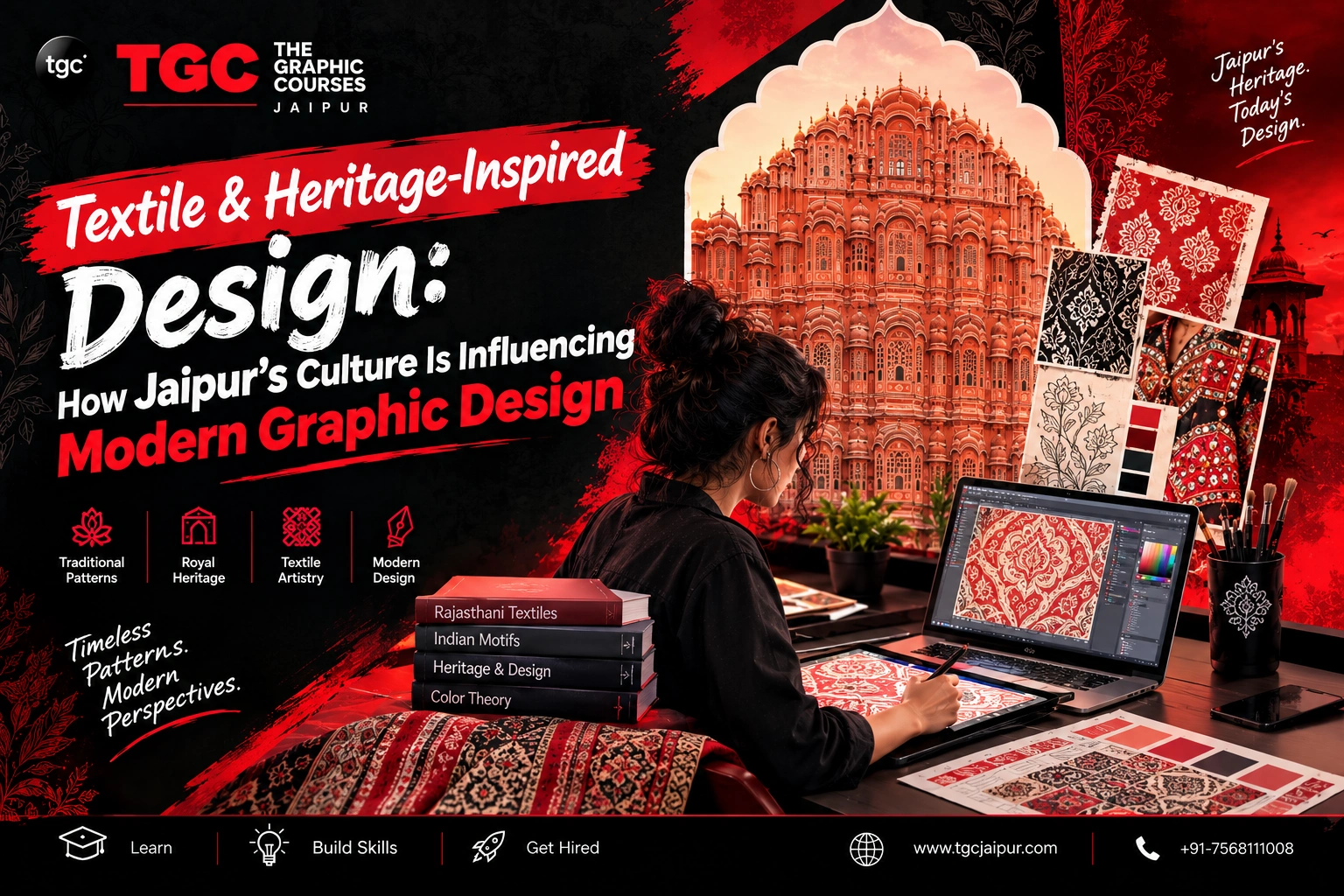
Walk through Jaipur's old city and you're surrounded by design lessons most graphic designers spend years trying to learn from textbooks: bold, confident color pairing on the Pink City's facades, intricate repeat patterns in Bagru and Sanganeri block prints, and the precise geometric symmetry of Rajasthani jharokhas and jaali work. Long before "pattern design" became a course module or a Behance category, Jaipur's artisans were mastering it — through fabric, stone, and paint.
Today, that heritage is finding its way back into modern graphic design not as nostalgic decoration, but as a genuine source of contemporary visual language for branding, packaging, and digital design. For designers training in Jaipur specifically, this local cultural inheritance is a genuine creative advantage, if you know how to translate it into modern design work.
Why Jaipur's Design Heritage Matters Beyond Tourism
It's easy to file Jaipur's textile and craft traditions under "tourism" or "heritage preservation" beautiful, but separate from "real" design work. That framing misses something important: the principles behind these traditional art forms are the exact same principles taught in modern design fundamentals color theory, pattern repetition, balance, and visual hierarchy refined over centuries of practical, commercial craft.
Understanding this connection gives Jaipur-based designers a genuine edge: a visual vocabulary that's authentically local, difficult for designers elsewhere to replicate convincingly, and increasingly in demand as brands chase distinctive, non-generic visual identities.
Block Printing: A Masterclass in Pattern and Repeat Design
Jaipur and its neighboring town of Bagru are globally recognized centers of hand block printing a craft that is, at its core, an exercise in the same repeat-pattern design principles taught in modern textile and surface pattern design courses.
What modern designers can learn from it:
- Modular repeat systems — block prints rely on a single carved unit repeated across a surface with mathematical precision, a foundational skill directly applicable to digital pattern design, packaging, and textile-inspired branding
- Controlled color palettes — traditional Sanganeri and Bagru prints typically work within a disciplined palette (indigo, madder red, natural dyes), demonstrating how restraint often creates more sophisticated results than unlimited color choices
- Motif simplification — traditional block motifs (florals, paisleys, geometric borders) are often simplified, stylized versions of natural forms the same design logic behind modern logo and icon design
Designers studying these motifs closely often find they translate beautifully into modern applications: packaging for wellness or lifestyle brands, textile-inspired social media templates, and even UI background patterns for apps wanting a distinctly Indian aesthetic.
Rajasthani Miniature Art: Color, Composition, and Storytelling
Rajasthani miniature painting with its intricate detailing, vivid natural pigments, and narrative-driven compositions offers a completely different but equally valuable design lesson: how to tell a story within a tightly composed frame.
Design principles worth studying:
- Bold, saturated color combinations that shouldn't theoretically work together (deep blues against warm ochres, bright pinks against forest greens) but create striking, memorable visual impact
- Layered visual hierarchy — miniature paintings often guide the eye through a scene using scale, framing, and strategic detail placement, a skill directly relevant to poster design, editorial layouts, and infographic design
- Decorative borders and framing devices — many miniatures use ornamental borders that echo the painting's theme, a technique modern designers can adapt for packaging, certificates, and branded stationery
Brands wanting to signal authenticity, luxury, or a distinctly Rajasthani identity increasingly draw on this visual language , and designers who understand its underlying structure (not just its surface appearance) can execute it far more convincingly than those simply copying reference images.
Jaipur's Architecture: Geometry, Symmetry, and Jaali Work
The city's architecture , from Hawa Mahal's honeycomb facade to the intricate marble jaali (lattice) screens found across forts and havelis, is essentially a masterclass in geometric pattern design, executed centuries before digital grid systems existed.
What this teaches modern designers:
- Precision symmetry — jaali work relies on exact geometric repetition, a principle directly transferable to modern logo grids, icon systems, and pattern-based backgrounds
- Negative space as a design element — jaali screens use carved-out space as intentionally as solid material, a lesson in how emptiness itself can carry visual weight highly relevant to minimalist and modern branding work
- Color as architectural identity — Jaipur's signature pink-terracotta palette (mandated by royal decree in the 19th century, and maintained ever since) demonstrates how a disciplined, consistent color identity can define an entire visual brand exactly what modern brand guidelines aim to achieve at a smaller scale
How Global and Indian Brands Are Already Using This Aesthetic
This isn't a theoretical exercise — heritage-inspired, textile-influenced design has become a genuine, visible trend across multiple industries:
- Fashion and lifestyle branding — increasingly incorporating block-print-inspired patterns, motifs, and color stories into packaging and digital campaigns
- Hospitality and tourism design — hotels and travel brands across Rajasthan lean heavily into heritage visual language for branding, signage, and marketing materials
- Wellness and D2C brands — a growing number of Indian D2C brands use Rajasthani textile motifs and miniature-art-inspired illustration to signal authenticity and cultural rootedness
- Digital and app design — some Indian apps and platforms incorporate subtle jaali-inspired geometric patterns as background textures or loading animations, adding cultural distinctiveness to otherwise generic digital interfaces
How to Translate Heritage Motifs Into Modern Design (Without It Feeling Dated)
The biggest risk when drawing on traditional art forms is producing something that feels like a costume-department cliché rather than genuinely contemporary design. A few principles help avoid this:
- Study the underlying structure, not just the surface pattern — understand why a block print repeat works mathematically, rather than just tracing a motif
- Simplify aggressively — traditional motifs are often highly detailed; modern applications (especially digital) usually benefit from a simplified, more graphic interpretation
- Use restraint in application — a single heritage-inspired accent (a border, a background texture, one signature color) often reads as more sophisticated than covering an entire design in traditional pattern
- Pair traditional elements with modern typography — contrasting an intricate traditional motif with clean, contemporary type creates the "heritage meets modern" tension that makes this aesthetic feel current rather than nostalgic
- Understand the cultural context — motifs carry meaning; understanding what a pattern traditionally represents helps avoid using it in a way that feels hollow or disconnected from its roots
Why This Matters for Aspiring Designers in Jaipur
For students building a graphic design career in Jaipur specifically, this local heritage isn't just an interesting side note it's a genuine creative asset. Clients increasingly want designers who can authentically translate cultural and regional identity into modern branding, rather than generic global design trends that could belong to any city in the world. A Jaipur-based designer who deeply understands local textile traditions, color history, and architectural pattern language has a distinctive edge that's difficult for outsiders to replicate convincingly.
This is exactly the kind of cultural and creative depth that elevates a portfolio beyond generic tutorial exercises — a heritage-inspired branding project, a block-print-influenced packaging concept, or a jaali-pattern-based digital design all make for genuinely distinctive portfolio pieces that few other candidates will have.
Where to Build These Skills in Jaipur
TGC Jaipur's Graphic Design Course with AI Tools gives students the design fundamentals color theory, typography, composition, and branding needed to study and reinterpret heritage design elements thoughtfully, while also covering the modern AI-assisted workflows increasingly expected in the industry today. Students work on real, portfolio-ready projects, making it entirely possible to build a heritage-inspired branding or packaging concept as part of coursework.
Students in different parts of the city can access the same practical training through location-specific batches, including the Graphic Design Course in Mansarovar and the Graphic Design Course in Ashok Nagar.
For students interested in the complete range of creative and tech programs, TGC Jaipur's course catalog covers everything from graphic design and UI/UX to web development and AI-integrated design tools.
Final Thoughts
Jaipur's textile traditions, miniature art, and architectural heritage aren't just beautiful historical artifacts; they're a genuinely rich, sophisticated design language that predates modern graphic design theory by centuries, built on the exact same principles of pattern, color, and composition taught in design courses today. For designers training in Jaipur, this cultural inheritance offers a rare creative advantage: an authentic, distinctive visual vocabulary that global design trends simply can't replicate.
The designers who learn to study this heritage seriously, understanding its structure and meaning, not just copying its surface, are the ones who'll bring genuinely original, culturally rooted work into an industry increasingly hungry for authenticity over generic trends.
Ready to build a design career rooted in genuine creative depth? Explore TGC Jaipur's Graphic Design courses and learn to blend heritage-inspired creativity with modern, industry-ready design skills.
Recently Added Articles
.webp)





 Book A Free Demo
  7568111008
 Apply Now


 Please select course category