





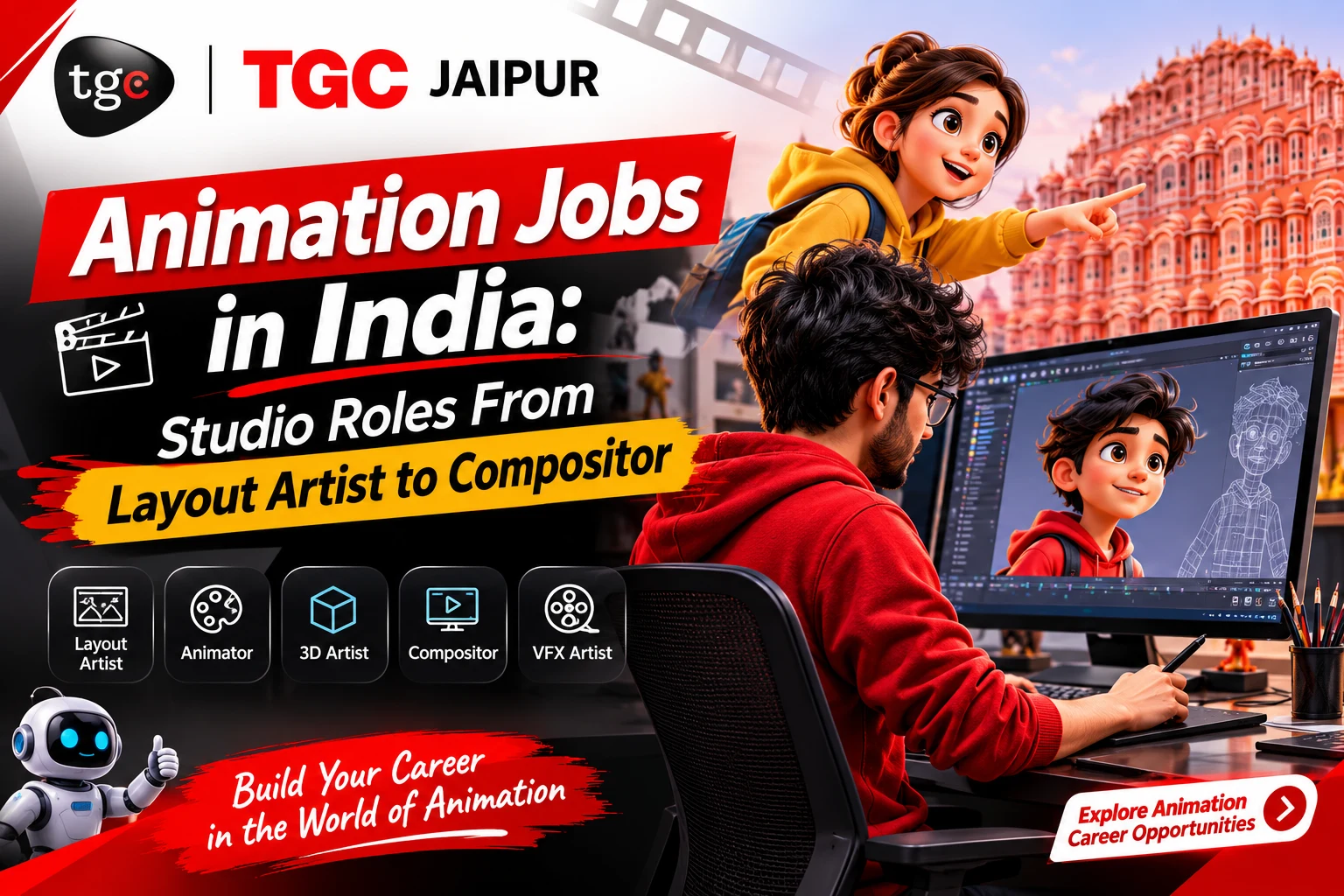
Animation Jobs in India: Studio Roles From Layout Artist to Compositor
Last updated on Oct 31, 2026


Introduction
Most people think "animation job" means one thing: an animator moving a character. In a real studio, that's just one seat in a long production line. A single animated film, web series, ad, or game cinematic passes through dozens of specialists, each handling a different stage, and each one is a separate career path.
If you're a student in Jaipur wondering what job you can actually aim for, understanding the studio pipeline is the best place to start. This guide walks through the major animation and VFX roles in India, from layout artist to compositor, what each person does, which software they use, what skills employers expect, and how to move toward the role that fits you.
If you're a student in Jaipur wondering what job you can actually aim for, understanding the studio pipeline is the best place to start. This guide walks through the major animation and VFX roles in India, from layout artist to compositor, what each person does, which software they use, what skills employers expect, and how to move toward the role that fits you.
How an Animation Studio Is Organized
Studios break production into three broad phases:
| Phase | What Happens | Example Roles |
|---|---|---|
| Pre-production | Ideas, story, design, and planning | Concept artist, storyboard artist, character designer, background artist |
| Production | Building and animating the assets and shots | Layout artist, modeler, texture artist, rigger, animator, lighting artist, FX artist |
| Post-production | Assembling, polishing, and delivering | Compositor, editor, colorist, sound team |
Understanding where each role sits helps you see how your skills fit into the bigger picture, and which stage excites you most.
Pre-Production Roles
Concept Artist
What they do: Visualize characters, environments, props, and mood before anything is built. They set the look of the project.
Skills and tools: Strong drawing, color, and design sense; Photoshop, Procreate, and sometimes 3D tools for quick studies.
Good fit if you: Love illustration and world-building.
Storyboard Artist
What they do: Turn a script into a sequence of drawn panels that plan shots, camera angles, and pacing.
Skills and tools: Drawing, cinematic thinking, and storytelling; Storyboard Pro, Photoshop, or Toon Boom.
Good fit if you: Enjoy telling stories visually and thinking like a director.
Character Designer
What they do: Design how characters look, including proportions, costumes, expressions, and model sheets that the whole team follows.
Skills and tools: Anatomy, shape language, and consistency; Photoshop, Illustrator, and sketching.
Background and Environment Artist
What they do: Paint or design locations and settings in which the action takes place.
Skills and tools: Perspective, lighting, color, and composition; Photoshop and 3D tools.
Production Roles
Layout Artist
What they do: Layout sits between story and animation. The layout artist stages each shot: placing characters, props, and the camera, deciding angles, framing, and movement, and making sure the shot follows the storyboard and works with the environment. In 3D pipelines, they often block the scene in 3D space so animators receive a clear, camera-ready setup.
Skills and tools: Composition, cinematography basics, perspective, spatial thinking, and an understanding of timing; Maya, Blender, or similar 3D software.
Good fit if you: Like cinematography and organizing a scene, and enjoy being the bridge between story and animation.
3D Modeler
What they do: Build characters, props, vehicles, and environments in 3D.
Skills and tools: Anatomy, topology, hard-surface and organic modeling; Maya, Blender, ZBrush.
Texture and Surfacing Artist
What they do: Add color, material, and surface detail so models look like skin, metal, cloth, or stone.
Skills and tools: Material understanding and painting; Substance Painter, Photoshop, and shader tools.
Rigger
What they do: Build the skeleton and controls that let animators pose and move a model.
Skills and tools: Technical thinking, anatomy, and scripting; Maya or Blender, often with Python.
Good fit if you: Enjoy solving technical puzzles.
Animator (2D or 3D)
What they do: Bring characters and objects to life, creating performance, emotion, and believable movement.
Skills and tools: The 12 principles of animation, acting, timing, and observation; Maya, Blender, Toon Boom, Adobe Animate.
Good fit if you: Love performance and character.
Lighting Artist
What they do: Light scenes to create mood, depth, and visual style, and prepare shots for rendering.
Skills and tools: Color theory, cinematography, and rendering knowledge; Maya, Blender, and rendering engines.
FX Artist
What they do: Create fire, smoke, water, dust, destruction, and magic effects, usually through simulation.
Skills and tools: Physics intuition, procedural thinking, and technical problem-solving; Houdini, Maya, Blender.
Good fit if you: Enjoy technical craft and procedural problem-solving. This is also among the better-paid specializations.
Rotoscopy and Paint Artist
What they do: Isolate elements frame by frame and clean up footage, such as removing wires, rigs, or unwanted objects.
Skills and tools: Patience, accuracy, and observation; Nuke, After Effects, Silhouette.
Why it matters: A common entry point into VFX, and a good way to learn how shots are built.
Matchmove and Tracking Artist
What they do: Recreate the real camera's movement in 3D so CG elements sit correctly in live-action footage.
Skills and tools: Spatial reasoning and technical accuracy; 3D tracking software and Nuke.
Post-Production Roles
Compositor
What they do: Combine every layer, such as live footage, 3D renders, effects, and backgrounds, into the final image. They match color, lighting, grain, and perspective so everything looks like it was filmed together.
Skills and tools: Strong visual judgment, color matching, and technical precision; Nuke and Adobe After Effects.
Good fit if you: Have a sharp eye and enjoy making things look real. Compositing is often described as the final quality gate of a shot.
Video Editor and Finishing Artist
What they do: Cut shots into scenes, control pacing, grade color, and finalize deliverables.
Skills and tools: Storytelling, rhythm, and color; Premiere Pro, DaVinci Resolve, Final Cut Pro.
Motion Graphics Designer
What they do: Create animated titles, graphics, logos, and explainer visuals for ads, channels, and digital content.
Skills and tools: Design sense and animation timing; After Effects, Cinema 4D.
Roles at a Glance
| Role | Stage | Main Software | Entry Difficulty |
|---|---|---|---|
| Storyboard artist | Pre-production | Storyboard Pro, Photoshop | Moderate, drawing heavy |
| Concept and character designer | Pre-production | Photoshop, Illustrator | Competitive, portfolio driven |
| Layout artist | Production | Maya, Blender | Moderate |
| Modeler | Production | Maya, Blender, ZBrush | Moderate |
| Texture artist | Production | Substance Painter | Moderate |
| Rigger | Production | Maya, Python | Technical |
| Animator | Production | Maya, Blender, Toon Boom | Competitive |
| Lighting artist | Production | Maya, Blender | Moderate |
| FX artist | Production | Houdini | Technical, specialized |
| Roto and paint artist | VFX | Nuke, After Effects | Common starting point |
| Matchmove artist | VFX | Tracking tools, Nuke | Technical |
| Compositor | Post-production | Nuke, After Effects | Moderate to advanced |
| Editor | Post-production | Premiere Pro, DaVinci Resolve | Accessible |
| Motion graphics designer | Post-production | After Effects, Cinema 4D | Accessible |
What Do These Jobs Pay in India?
Salaries vary widely by role, city, studio, and portfolio. Industry salary data for India in 2026 generally shows these directional ranges:
| Role or Level | Typical Annual Range (directional) |
|---|---|
| Entry-level 3D animator | About ₹3 lakh to ₹4 lakh |
| 3D animator, 3 to 5 years | About ₹5 lakh to ₹8 lakh |
| Senior or lead animator | About ₹10 lakh to ₹15 lakh and above |
| Roto artist | About ₹2.5 lakh to ₹4 lakh |
| Matchmove artist | About ₹3 lakh to ₹6 lakh |
| Compositor | About ₹3 lakh to ₹7 lakh |
| FX technical artist (Houdini) | About ₹8 lakh to ₹20 lakh |
| VFX supervisor | About ₹12 lakh to ₹25 lakh |
These figures are guides, not guarantees, and they differ by studio type and city. The pattern is consistent, though: specialized, technical roles such as FX and advanced compositing generally pay more than entry-level generalist roles, and pay rises sharply with experience and a strong showreel. Layout, modeling, lighting, and other production roles vary widely by studio, so check current listings for your target role.
Where Animation Jobs Exist in India
| Employer Type | What They Hire For |
|---|---|
| Animation studios | Series, films, and kids' content |
| VFX houses | Film, OTT, and commercial effects work |
| Advertising and production agencies | Motion graphics, 2D and 3D ads, explainers |
| Gaming companies | Character, environment, and animation work |
| OTT and media companies | Titles, effects, and post-production |
| Ed-tech and corporate content teams | Explainer and training animation |
| Architecture and product visualization firms | 3D visualization and walkthroughs |
| Freelance and remote clients | Project-based work for studios in India and abroad |
Major hubs include Mumbai, Bengaluru, Hyderabad, Chennai, Pune, and Delhi NCR, but remote and outsourced work increasingly lets artists in cities like Jaipur contribute to projects without relocating.
How to Choose Your Role
Ask yourself what you enjoy most:
| If you love... | Consider |
|---|---|
| Drawing and story | Storyboard, concept, or character design |
| Cinematography and scene planning | Layout artist |
| Sculpting and building things | Modeling or texturing |
| Technical puzzles and logic | Rigging, FX, or matchmove |
| Acting and emotion | Character animation |
| Light and mood | Lighting artist |
| Making things look real | Compositing |
| Rhythm and design | Motion graphics or editing |
You don't need to decide on day one. A good course exposes you to the whole pipeline so you can discover which stage you enjoy and do best.
How to Get Hired: A Practical Path
- Learn the fundamentals first. Drawing, timing, composition, and the 12 principles of animation support every role
- Understand the whole pipeline. Knowing what comes before and after your role makes you easier to work with
- Pick a specialization. After exploring, focus your portfolio on one or two roles
- Build a role-specific showreel. A layout reel, an animation reel, and a compositing reel are not the same thing
- Keep it short and strong. Aim for 60 to 90 seconds of your best work, with breakdowns where useful
- Apply widely. Studios, agencies, and freelance clients all hire differently
- Start with a trainee or junior role. Roto, paint, or junior animation positions are common entry points
- Keep learning. Software and workflows evolve, including AI-assisted tools
What Your Showreel Should Show for Each Role
| Role | Showreel Should Include |
|---|---|
| Layout artist | Camera staging, composition choices, and shot continuity |
| Animator | Strong acting, weight, and timing in short clips |
| Modeler and texture artist | Clean wireframes, turntables, and realistic materials |
| Rigger | Rig demos showing range of motion and controls |
| Lighting artist | The same scene lit for different moods |
| FX artist | Simulations with clear breakdowns of how they were built |
| Compositor | Before-and-after breakdowns that show integration |
| Motion graphics designer | Titles, logos, and explainers with polished timing |
Common Mistakes Students Make
- Aiming only for "animator." Many strong careers exist in layout, lighting, FX, and compositing
- Skipping fundamentals. Software skill without design and timing skill shows quickly
- Making a generic reel. Studios hire for specific roles
- Including too much weak work. Show your best, not everything
- Ignoring the pipeline. Collaboration is a big part of studio life
- Expecting instant senior roles. Most careers start with trainee or junior positions
- Not practicing consistently. Skill grows through steady repetition
Where to Build Animation Skills in Jaipur
TGC Jaipur's 3D Animation and VFX course covers the complete production pipeline, including modeling, texturing, lighting, rigging, animation, dynamics, and compositing, using industry-standard tools such as Maya, Houdini, Nuke, and Adobe After Effects, with a focus on building a professional showreel by the end of the course. That breadth lets you explore several of the roles above before choosing your specialty.
For students who want to focus on effects and compositing, the VFX Course in Jaipur concentrates on realistic effects, simulation, and compositing work. For a longer, more comprehensive program, the Diploma in Animation and VFX covers the full pipeline, including AI-assisted workflows, in preparation for real production environments. Students in specific parts of the city can join the Animation Course in Vaishali Nagar, and those who want to add editing and finishing skills can explore the Video Editing course.
Frequently Asked Questions
What jobs are available in animation in India? Roles include storyboard artist, concept and character designer, layout artist, modeler, texture artist, rigger, animator, lighting artist, FX artist, roto and matchmove artist, compositor, editor, and motion graphics designer.
What does a layout artist do? A layout artist stages each shot by placing characters, props, and the camera, deciding framing and movement, and preparing the scene for animators, based on the storyboard.
What does a compositor do? A compositor combines live footage, 3D renders, effects, and backgrounds into one believable final image, matching color, lighting, and perspective.
Which animation role pays the most? Specialized technical roles such as FX artists and VFX supervisors generally pay the most, followed by experienced animators and compositors. Pay depends heavily on skill, portfolio, and studio.
Is animation a good career in India? It can be, with growing demand from OTT, advertising, gaming, and VFX work. Success depends on skill, a strong showreel, and persistence.
Do I need to draw well to work in animation? Drawing is essential for roles like storyboard and concept art, and helpful for animation. Technical roles such as rigging, FX, and compositing rely more on technical and observational skill.
Can I work in animation from Jaipur? Yes. Local agencies and studios exist, and remote and outsourced projects allow artists in tier-2 cities to work with studios elsewhere in India and abroad.
What should I start with as a fresher? Entry points often include roto and paint, junior animation, editing, or motion graphics roles. Build your showreel while you work and move toward your preferred specialization.
How long does it take to become job-ready? It depends on your starting point and practice. A structured course gives you the pipeline and a portfolio, but most artists keep improving their reel for months before landing a role.
Final Thoughts
An animation studio is a team sport. For every character you see on screen, there's a storyboard artist, a layout artist, a modeler, a rigger, an animator, a lighting artist, and a compositor, each contributing a piece. That's good news for students, because it means there's more than one door into the industry.
Learn the fundamentals, understand the pipeline, find the stage that fits your strengths, and build a showreel aimed at that role. Whether you end up staging shots as a layout artist or giving them their final polish as a compositor, there's a place for you in the process.
Ready to explore the animation pipeline and find your role? Explore TGC Jaipur's Animation and VFX courses and start building your showreel.
Recently Added Articles

.webp)
.png)
.webp)


 Book A Free Demo
 7568111008
 Apply Now


 Please select course category