





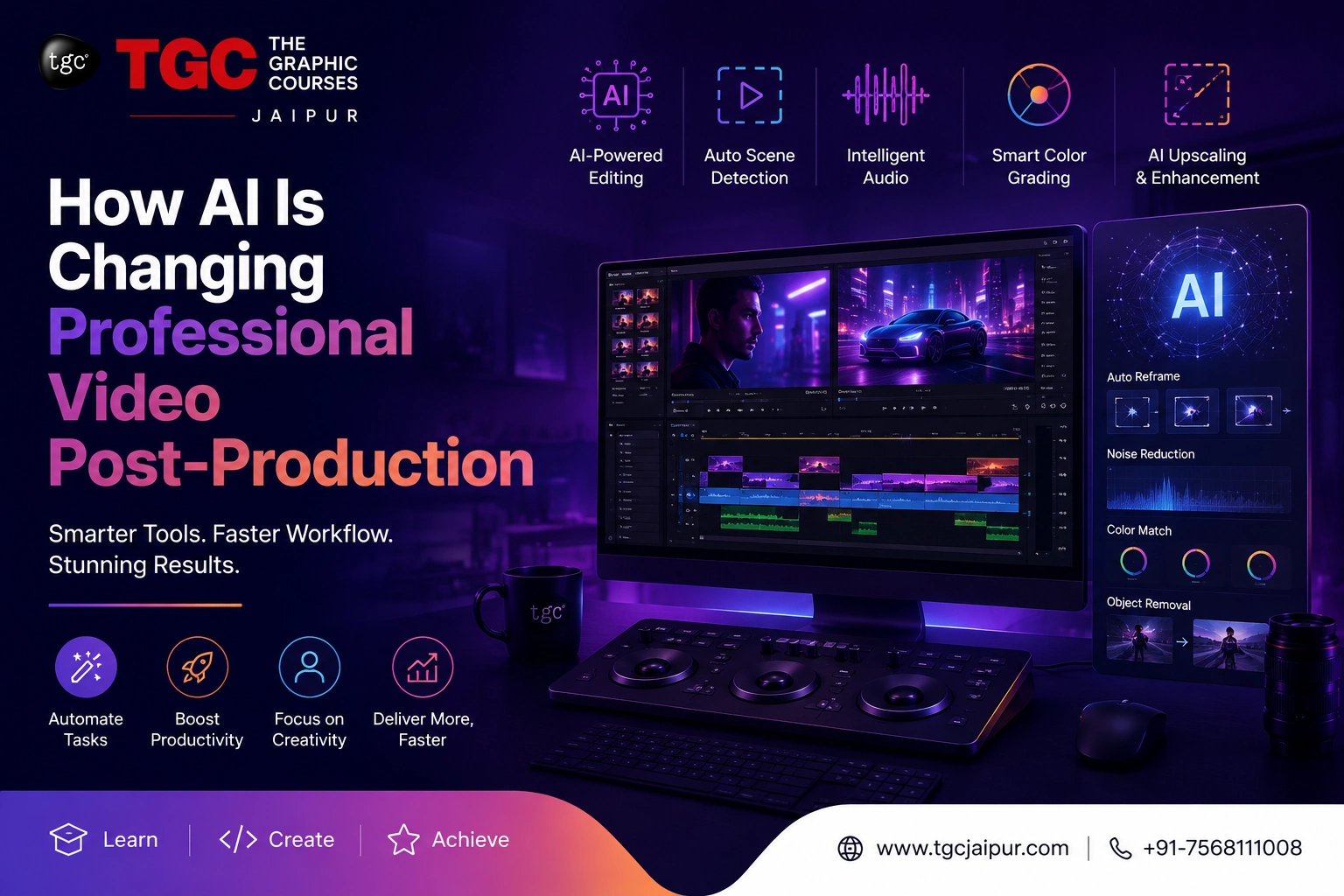
How AI Is Changing Professional Video Post-Production
A few years ago, “post-production” meant hours spent manually syncing audio, scrubbing through footage to find the right take, and painstakingly color-grading scene after scene. Today, a growing share of that work can be accelerated — or in some cases, done almost entirely — by artificial intelligence.
AI hasn’t replaced video editors. But it has fundamentally changed how they work, what tasks they spend time on, and what skills studios and clients now expect. For anyone building a career in video editing and post-production, understanding this shift isn’t optional anymore — it’s becoming a core professional skill.
This blog breaks down exactly how AI is reshaping post-production workflows, which tasks it’s transforming first, and why editors who learn to work with AI — not against it — are the ones getting hired faster.
Why AI Is Entering Post-Production Now
Video post-production has always been time-intensive: reviewing hours of raw footage, cutting for pacing, syncing audio, correcting color, and polishing final output. AI tools are being adopted precisely because they target the most repetitive, time-consuming parts of that process — freeing editors to focus on the creative decisions that actually require human judgment.
This shift is happening across nearly every stage of the editing pipeline.
1. AI-Powered Rough Cuts and Footage Organization
One of the most time-consuming parts of editing has always been simply finding the right shot among hours of raw footage. AI is changing that dramatically.
- Automatic scene detection tags and organizes clips by content, motion, or dialogue — no more scrubbing endlessly through raw footage.
- AI-generated rough cuts can assemble a rough sequence based on a script, transcript, or set of instructions, giving editors a starting point instead of a blank timeline.
- Smart search lets editors find a specific line of dialogue or visual moment across hours of footage in seconds, using AI-powered transcription and indexing.
This doesn’t eliminate the editor’s role — it removes hours of manual searching, so editors spend more time actually crafting the story.
2. Automated Transcription and Multi-Language Subtitling
AI-driven speech-to-text tools have transformed what used to be one of the most tedious post-production tasks. Editors can now:
- Generate accurate transcripts of interviews and dialogue automatically.
- Auto-generate subtitles and captions in multiple languages within minutes
- Edit video by editing the transcript text itself — cutting a sentence from the transcript cuts the corresponding video clip.
For content creators and studios producing videos for global or multi-platform distribution, this single AI application alone has cut turnaround time dramatically.
3. AI-Assisted Color Grading
Color grading has traditionally required a trained eye and hours of manual adjustment, shot by shot. AI is now speeding up this process significantly:
- Automatic scene matching analyzes lighting and tone across multiple clips and applies consistent color correction automatically.
- AI-suggested grading presets analyze footage and recommend a starting look based on mood, genre, or reference footage.
- Skin tone and exposure correction can be handled automatically, reducing the manual grading workload for editors.
Editors still make the final creative call — but AI dramatically reduces the time spent on baseline corrections before the real creative grading begins.
4. Audio Cleanup and Sound Design
AI has made a particularly strong impact in audio post-production, an area that used to require specialized sound engineers for even basic fixes:
- AI noise reduction removes background hiss, hum, and unwanted sounds without degrading dialogue quality.
- Automatic audio leveling balances dialogue, music, and effects across a timeline
- AI-generated sound effects and ambient audio can fill gaps in a scene without needing a full sound library search.
This means editors working solo — a common reality for freelancers and content creators — can now deliver studio-quality audio without needing a dedicated audio engineer for every project.
5. Generative AI for VFX and Motion Graphics
Perhaps the most visible AI shift is happening in visual effects and motion graphics, where generative AI tools now assist with:
- Object removal and background replacement without traditional rotoscoping
- AI-powered motion tracking for compositing effects onto moving footage
- Generative backgrounds and elements that would previously require manual 3D modeling or stock footage
- Auto-generated title sequences and lower thirds based on brand guidelines or style references
Tools like Adobe After Effects have increasingly integrated generative AI features directly into the editing workflow, allowing motion designers to iterate faster on ideas that once took hours to build from scratch.
6. Smarter, Faster Editing Decisions
Beyond individual tasks, AI is starting to influence higher-level editing decisions too:
- Pacing and rhythm suggestions based on analysis of successful content in a given genre or platform.
- Platform-specific reformatting — automatically reframing a horizontal video into vertical or square formats for social media, with AI detecting the most important part of the frame.
- Predictive engagement analysis for content creators, showing which cuts or thumbnails are likely to perform better.
These tools don’t replace editorial judgment, but they give editors data-informed starting points, especially valuable for high-volume content like social media and YouTube.
What This Means for Editors: Skills That Matter Now
AI isn’t eliminating video editing jobs — but it is changing what makes an editor valuable. The editors thriving in this new landscape are the ones who combine strong traditional editing fundamentals with fluency in AI-assisted tools.
Skills that matter more than ever:
- Traditional editing craft — pacing, storytelling, and timing still require human judgment that AI can’t replicate
- AI tool literacy — knowing which AI features to use, when, and how to refine their output
- Prompt-based editing workflows — describing desired outcomes to AI tools effectively, much like working with a junior assistant
- Quality control — reviewing and correcting AI-generated cuts, grades, and effects, since AI output still needs a trained eye to polish
This blend of classic craft and modern AI fluency is exactly what employers are now screening for in post-production hires.
Where to Learn AI-Powered Post-Production
Because this shift is happening so fast, formal training has become one of the fastest ways to build these combined skills rather than trying to piece them together from scattered tutorials.
TGC Jaipur’s Video Editing with AI course is built specifically around this shift — combining core editing skills in Adobe Premiere Pro, DaVinci Resolve, and Final Cut Pro with AI-powered workflows for faster, smarter editing. Students work on real footage, ad creatives, and YouTube-style content while learning how to integrate AI tools into a professional pipeline, not just as a novelty add-on.
For those focused specifically on motion graphics and visual effects, the After Effects with Generative AI course covers keyframing, compositing, and motion tracking alongside AI-assisted animation — exactly the blended skill set studios are hiring for today.
And for editors who want to build a broader, career-ready foundation across the full post-production pipeline, TGC Jaipur’s complete course catalog covers everything from Premiere Pro and DaVinci Resolve to animation, VFX, and AI-integrated design tools — all under one training program.
The Future: AI as a Creative Collaborator, Not a Replacement
The biggest misconception about AI in post-production is that it’s coming to replace editors. In reality, it’s replacing tasks — the repetitive, time-consuming parts of the job — while elevating the role of the editor as a creative decision-maker and storyteller.
Studios, OTT platforms, and content creators aren’t looking for editors who can only push buttons. They’re looking for editors who understand storytelling and know how to use AI to work faster, smarter, and at a scale that simply wasn’t possible a few years ago.
Final Thoughts
AI is genuinely transforming professional video post-production — from rough cuts and color grading to sound design and VFX. But the editors who succeed in this new era aren’t the ones who avoid AI; they’re the ones who master both the timeless fundamentals of editing and the new tools reshaping the industry.
For anyone starting or advancing a career in video editing, now is exactly the right time to build fluency in both.
Ready to future-proof your editing career? Explore TGC Jaipur’s Video Editing & Post-Production courses and learn how to combine professional editing craft with the AI tools shaping the industry’s future.
Recently Added Articles


.webp)





 Book A Free Demo
  7568111008
 Apply Now


 Please select course category